










Every day we use our teeth. Completely naturally, automatically and without thinking about it, we use them to break down our food, enjoy sweets, and show them unconsciously when we smile brightly. Along with our arms and legs, our teeth are among the most important tools for self-sufficiency that our body has to offer. So it's time to take a closer look at the human dentition. In today's blog post, we'll explain how the human dentition is structured and which teeth are assigned a special function.
Facts: Teeth in the Permanent Dentition
In life, we have two sets of natural teeth available: primary (baby) teeth and permanent teeth. Although our teeth are not yet visible at birth, their foundations are already laid in the jaw before birth. It takes about two decades for the last permanent tooth to emerge. The permanent dentition of adults usually consists of 32 teeth.
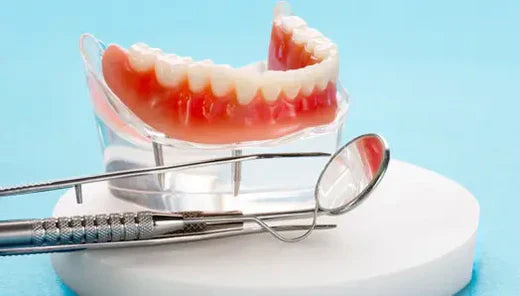
The 32 permanent teeth are divided between the upper and lower jaw. Per jaw and facial half, every adult has two incisors, one canine, and 5 molars, one of which is a wisdom tooth.
Incisors are located at the front of the jaw. They are relatively flat and in direct view. Their sharp, thin edges distinguish them. Functionally, they are perfect for biting off or dividing food.
Next to them are the canines. In contrast to the incisors, they are relatively pointed at the bottom. Their shape allows them to hold food when biting. Canines also assist in dividing food.
After the canines come the molars. They are no longer in direct view and begin with two smaller molars. These adjoin the two larger molars. Typical for molars is their large and uneven surface, which serves as a chewing surface. It is characterized by grooves and cusps. Their uneven structure allows for grasping and breaking down food. Molars are also called grinding teeth.
The large molars have significantly more root structure than all other teeth, comparatively. This makes them particularly firm in the jaw. The fifth molar is called a wisdom tooth. It does not erupt in everyone over the course of their life. In some people, the foundations are not present in the jaw.
Facts: Primary Dentition Compared to Permanent Dentition
The first teeth we get are our primary teeth. Unlike the permanent adult dentition, the primary dentition consists of only 20 teeth. Per jaw and facial half, the primary dentition consists of one incisor and four molars. In contrast to the permanent dentition, the primary dentition only has two primary canines in total.
The enamel of the primary dentition is significantly thinner than that of the permanent teeth. The mineral content of the primary dentition is also significantly lower. This is precisely why primary teeth are much more susceptible to cavities. Thorough brushing at a young age is therefore essential. Furthermore, it forms the basis of dental hygiene for all permanent teeth.
With our emmi®-dent ultrasonic toothbrush for children, you enable your child to have the perfect start to hygienic and professional dental care. Easy to use and thoroughly cleaning, it makes brushing teeth child's play for your child.